
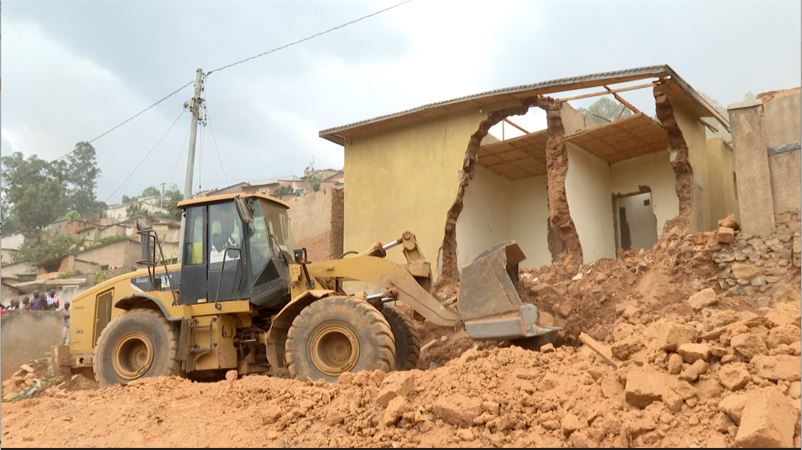
Families whose homes have been demolished or marked for removal say they were given inadequate notice, insufficient compensation and no secure alternatives. They are calling for a halt to further demolitions until authorities establish a fair, transparent and humane process.
KIGALI, Rwanda — Families across Kigali are facing homelessness after the demolition of houses that authorities say do not comply with building regulations. Residents affected by the demolitions say they were given little or no notice, offered inadequate financial assistance and, in some cases, left without alternative accommodation.
At least 222 houses have already been demolished out of 1,425 identified by the City of Kigali as non-compliant with construction requirements, according to Kigali Mayor Samuel Dusengiyumva. The affected properties are located in parts of Gasabo, Kicukiro and Nyarugenge districts, including Kagondo, Kibiraro, Kanombe—an area known as Akajagari, Nyarugunga—and Busanza.
Speaking during a City of Kigali General Assembly in february, Mayor Dusengiyumva emphasized the need to address unlawful construction and urged local authorities to do more to inform residents about building regulations. He acknowledged that demolishing a person’s home is deeply distressing and said that some demolitions could have been avoided through better public awareness and improved services at the local level.
Residents, however, say the official explanation does not address the hardship they are now experiencing.
“We are becoming refugees in our own country”Several residents interviewed for this report said some of the demolished houses were built after their owners had obtained permits or other documents from government authorities. They are questioning how properties that were previously approved, documented or tolerated by public officials could later be demolished without adequate compensation.
Residents also say that some affected families were offered 90,000 Rwandan francs—approximately €60, intended to cover three months of rent. However, they argue that this assistance is insufficient to secure suitable accommodation, particularly for households that have lost their homes, rental income or business premises.
For many, the dispute is about more than the loss of a building. They say the properties represented years of savings, loans, labor and sacrifice. Josephine Twagiramariya, a Kigali resident whose properties were affected, described the demolitions as a profound injustice.
“It took a great deal of effort and sacrifice for me to build my houses. I built them after obtaining the required permits from the government. Once they were completed, I rented them out—some were used for businesses, while others were rented as homes, with tenants paying me every month. Since they were first occupied, the properties had never caused any problems. I had built them legally and had the necessary permits issued by the government.”
Twagiramariya said residents were not seeking confrontation with the authorities. Instead, they want officials to recognize the value of what they have lost and provide families with enough time and resources to find alternative accommodation.
“The authorities should listen to affected residents and stop demolishing homes before fair compensation is provided. We are not asking for conflict. We are asking for justice, dignity and a fair process. Families should not simply be left homeless after losing everything they have worked for.”
Families say they were given only hours to leave
Nkubana Ephraim said his family had lived in the area for decades. He questioned how authorities could order residents to leave with only a few hours’ notice.
“We have lived here since 1989, for more than 30 years. I am a grandfather, and I am very surprised. There had never been any problem. How can the authorities come and order us to leave without giving us notice? They came at 3 p.m. and asked us to leave by 4 p.m. How is that possible?” Nkubana said residents were asking for reasonable time to find somewhere to live.
“We are not animals. We do not want to become refugees in our own country. We have land titles and we pay housing taxes every year.”
Mukamurenzi Dancilla, 62, said she was born in the area and was given little time to leave. She described being forced to move with her children and grandchildren.
“I was born here. I am 62 years old. I was shocked when people came to demolish our houses and told us to take our belongings and leave without compensation. We were left outside in the rain with our children.”
Mukamurenzi said police and DASSO personnel arrived late at night to inform residents that they would have to leave the following morning. She said the demolition took place early the next day, leaving her family without an alternative place to live.
Compensation and property valuations under scrutiny
Residents are also challenging the way their properties were assessed and valued. Twagiramariya said some properties were not properly assessed before demolition and that affected owners had not received a clear explanation of how compensation amounts were calculated. Residents allege that demolishing properties before compensation is paid has intensified their financial losses. Some say they borrowed money to build their homes, sold other assets or depended on rental income to support their families.
They argue that the central issue is not whether building regulations should be enforced, but whether enforcement is conducted transparently, consistently and in accordance with the rights of affected residents. A fair process would require authorities to provide written assessments, explain valuation methods, allow residents to challenge decisions and pay compensation before demolition takes place.
Children and vulnerable families face the greatest risks
The consequences extend beyond property ownership. Residents say families whose homes have been demolished have been left without adequate shelter. Children face disruption to their education, while families forced to move at short notice may be exposed to unsafe or overcrowded living conditions. For elderly people, households with children and families with limited financial resources, finding accommodation quickly can be nearly impossible.
The loss of a home can also mean the loss of a business, rental income, school stability and access to essential services. Urban planning and the enforcement of construction standards are legitimate responsibilities of government. But residents argue that development should not be pursued by pushing vulnerable families into homelessness or leaving them without an effective way to challenge official decisions.
Residents seek parliamentary and public oversight
Some affected residents have attempted to bring their concerns to elected representatives. Twagiramariya and other residents, said they tried to raise the issue with Frank Habineza, a Member of Parliament from the Democratic Green Party. They also said they attempted to meet him at Parliament but were prevented from entering the premises. Habineza later wrote to the Speaker of the Chamber of Deputies requesting an opportunity to raise what he described as “the urgent issue of the sudden demolition of citizens’ homes, which is causing distress to our citizens.
” He subsequently said he was not given the opportunity to raise the matter before Parliament. According to his account, he was told that residents needed to submit formal written complaints together with copies of their identity documents. The dispute raises an important question about accountability: when citizens believe that government action has harmed their property, livelihoods or basic welfare, what accessible mechanisms exist for them to seek redress?
A call for a fair and humane process
The residents interviewed for this report said they recognize the government’s responsibility to regulate urban development and enforce construction standards. Their concern is how those rules are being implemented and who bears the cost of enforcement.
Twagiramariya said the demand was simple: “We have laws that are supposed to protect citizens and their property. Those laws must also protect ordinary people. What we are asking for is not confrontation. We are asking to be heard, to be treated with dignity and to receive fair compensation for what we have lost.”
The government’s stated goal of ensuring orderly and lawful urban development does not remove its responsibility to protect the dignity, livelihoods and property rights of the people affected. For families who have already lost their homes, the issue is no longer only about construction regulations. It is about whether Kigali’s development can proceed without leaving citizens homeless, impoverished and without an effective avenue for justice.